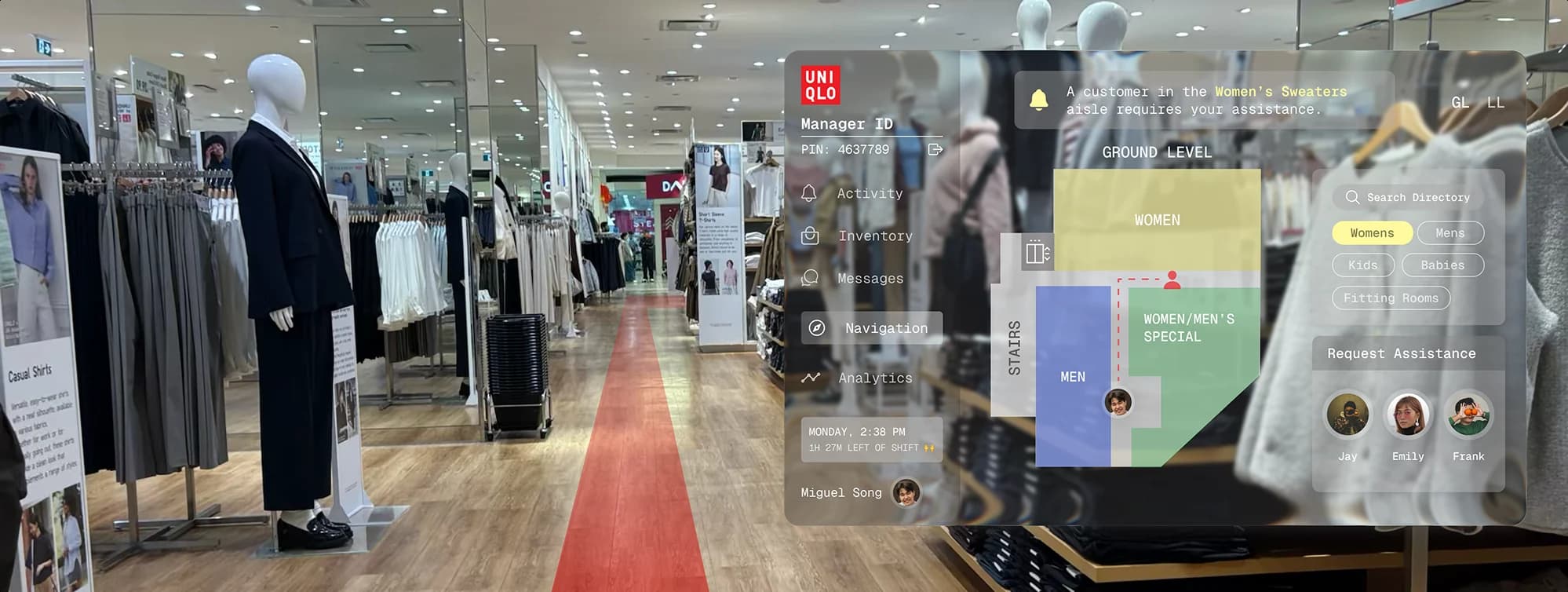
AR Glasses for Retail
- Role
- Designer
- Timeline
- Feb 6 – 23, 2026(2.5 week sprint)
- Skills
- Spatial DesignConceptual DesignInteraction Design
- Tools
- Figma
Context
“Technology is advancing, but how is it being used to adapt in specific areas in our society?”
This question was a topic frequently discussed within my Frontiers of Technology in Innovation class. The challenge was figuring out what existing technology could be applied to improve society.
Common pain points
I have some friends who currently work in retail/food service positions (Ex. Artbox, Fujiya, Vessi). These are some of the main tasks they run into during their shifts:




Knowing when the next box of shipments are coming in
Having to know specific promotions/
Checking availability in a different variation/stock at another store
Wearable tech was expanding faster than ever, and it made me wonder:
How might AR help Retail Workers in High-Traffic Malls with their Shifts?
Takeaways
Establishing moral grounds is a must with evolving technology.
As someone who’s worked in fast-paced environments (retail/food services), I could see how these glasses could be beneficial if used without ill intentions. However, I could also see how it could be used to micromanage and possibly displace employees.
Normalizes Invasion of Privacy
Customers did not consent to being observed through a worker's VR/AR glasses. Even without bad intent, features such as product scanning could accidentally capture customer faces or behaviour.
Accessibility at the Forefront
Workers who have visual impairments or sensory sensitivities might not be able to wear the glasses for a full shift, which can negatively impact their job performance.
Risks of Cognitive Offloading
With how all knowledge is condensed into one dashboard, it made me wonder: if anyone could put on these glasses as a way to rely on product knowledge, then what makes a “good employee”?
TLDR...
While I believe technology can be a tool that can help us in our daily lives, I also think we have to be intentional with the way we interact with it – what results we expect from using it and, in turn, how it affects the people around us.